CONTACT: CONtact-aware TACTile Learning for Robotic Disassembly

* Equal Contribution, Corresponding author, 1 Purdue University, 2 Texas A&M University
🎉 Accepted to IROS 2026!

Overview

Overall Pipeline

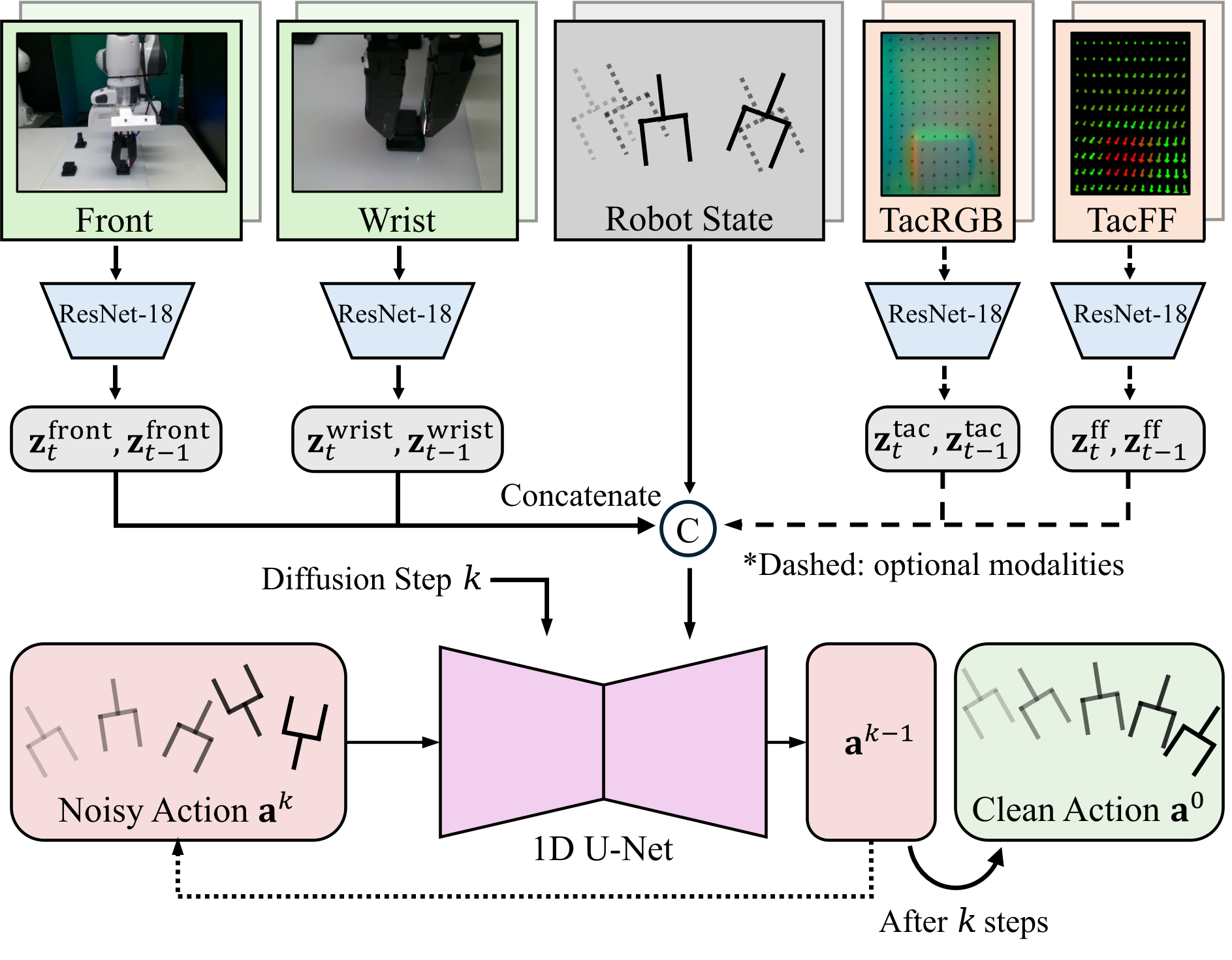
CONTACT is a systematic framework designed to investigate and enhance robotic disassembly through contact-aware tactile learning. While traditional vision-based methods often struggle with tight tolerances and deformable objects, our work demonstrates how structured tactile information can bridge the gap in these challenging, contact-rich scenarios.

Key Contributions

Task Suite
  • Diverse Task Suite: 10 challenging disassembly tasks across simulation and the real world, including rigid and deformable scenarios.
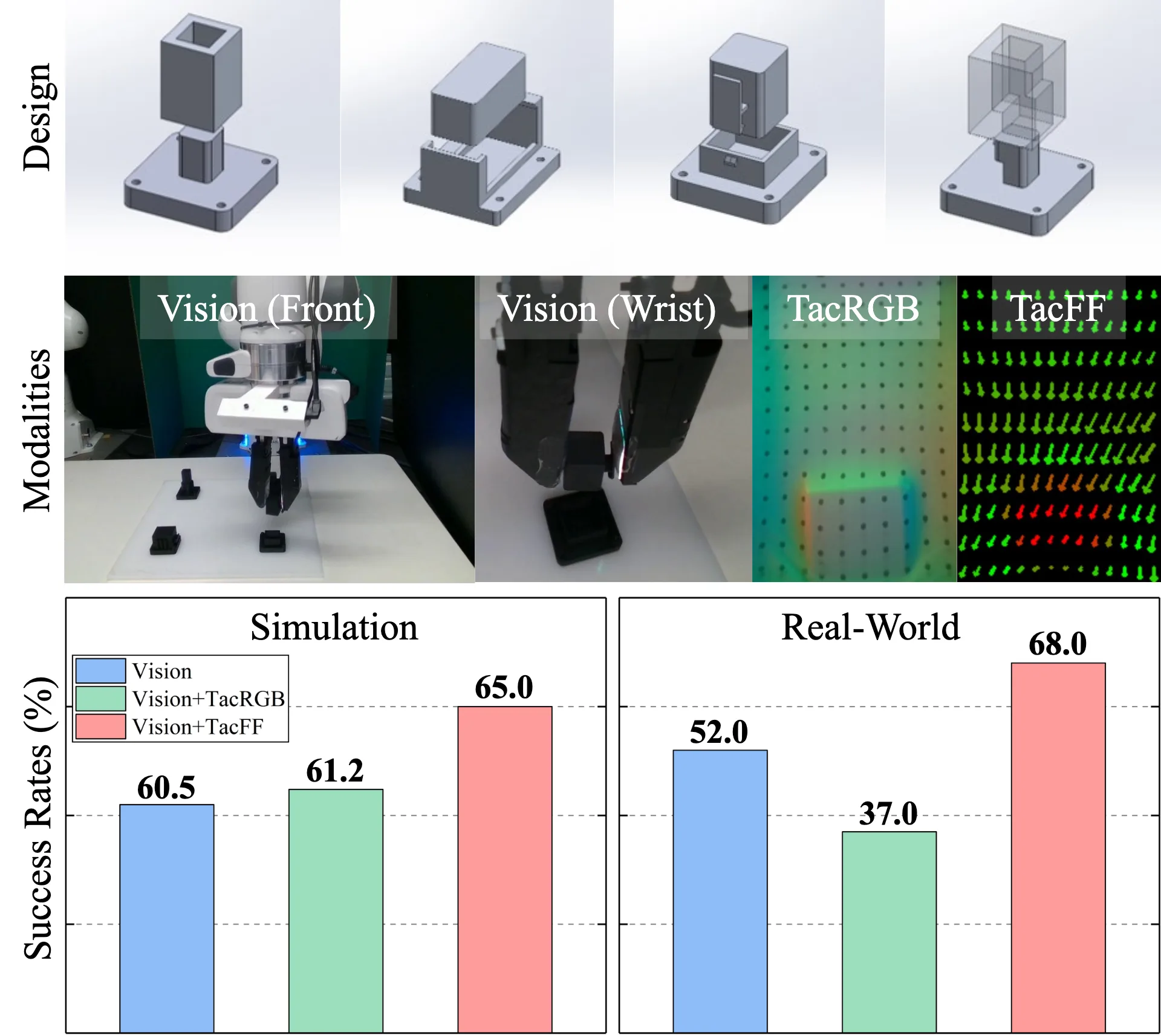
  • Tactile Representation: A comparative study of Vision Only, TacRGB (images), and TacFF (force fields).
  • Superior Performance: TacFF consistently achieves the highest success rates, proving that structured force-field representations are critical for robust, contact-rich manipulation.

Task Design

Task Suite

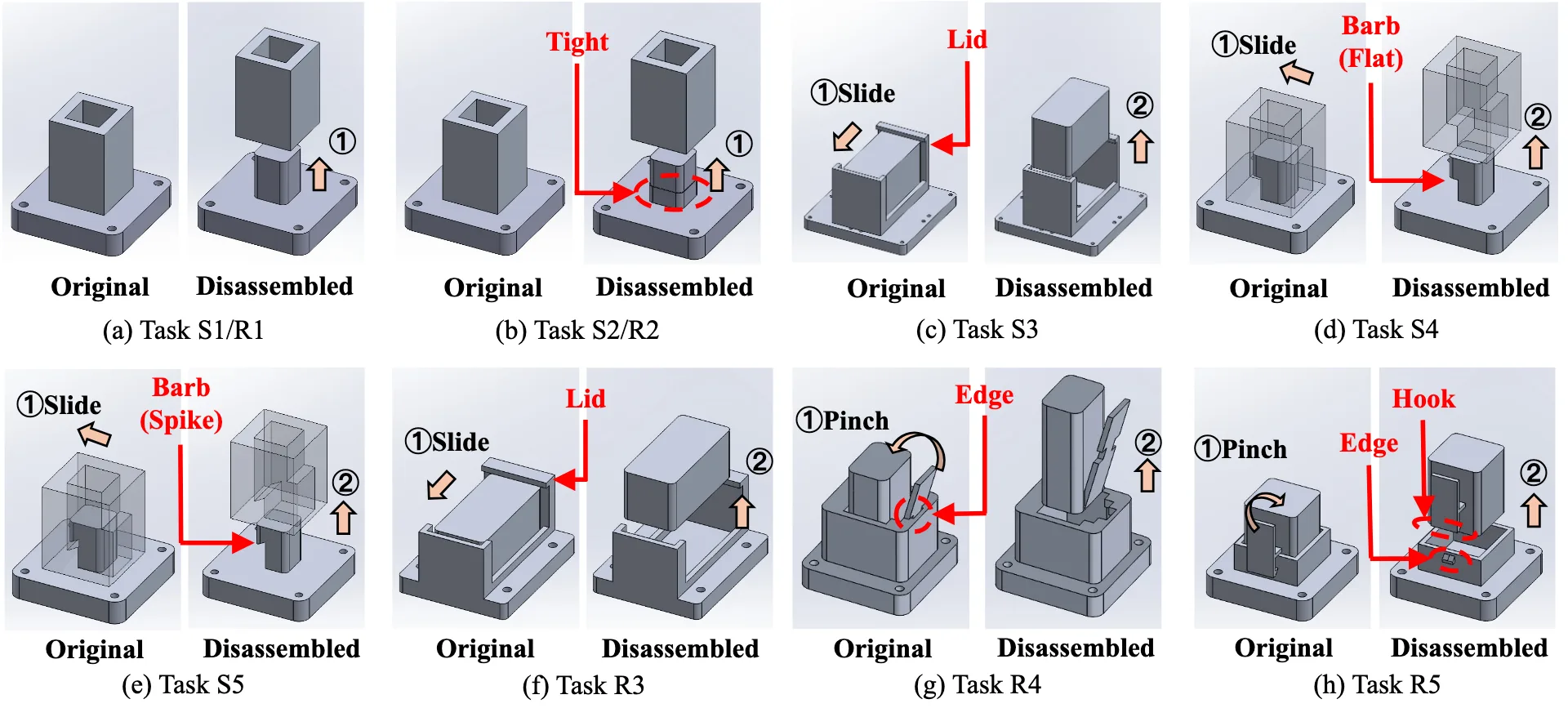
We designed a comprehensive suite of 10 disassembly tasks with increasing geometric and physical complexity, spanning both simulation and real-world environments.

Simulation Tasks (S1–S5)

Focused on rigid-body interactions under controlled conditions to evaluate how sensing modalities handle geometric constraints:

  • S1 & S2: Vertical pulling with loose/tight sockets to test alignment precision.
  • S3: A multi-stage task involving a lid-like constraint.
  • S4 & S5: Tasks featuring flat and spike barbs that introduce asymmetric contact resistance.

Real-World Tasks (R1–R5)

Incorporates physical variability and deformable components where successful manipulation depends on detecting subtle force changes:

  • R1 – R3: Rigid-body extractions matching simulation geometries to bridge the sim-to-real gap.
  • R4 (Push Tab): Requires compressing a deformable tab prior to release.
  • R5 (Vertical Clip): An elastic mechanism requiring controlled deformation to disengage a hook.

Video Highlights (Real-World)

We visualize representative rollouts across three key evaluation regimes: geometry-dominant, tight-tolerance, and visually degraded scenarios. The following results highlight the central findings of CONTACT: while vision is sufficient for simple geometry, structured tactile force fields (TacFF) are essential for mastering high-precision disassembly and maintaining robustness when visual perception is compromised.


1. Geometry-dominant task: modest gains

Vision-only — Success Rate 80%

Vision + TacFF — Success Rate 95%

Vision + TacRGB — Success Rate 90%

In geometry-dominant tasks, all three sensing configurations perform reasonably well. Tactile sensing provides only modest improvement because visual observations are already sufficient to guide manipulation in relatively structured settings. These examples (Task R1) show that tactile sensing is not uniformly beneficial across all disassembly tasks.


2. Tight tolerance task: structured force helps

Vision-only — Success Rate 55%

Vision + TacFF — Success Rate 70%

Vision + TacRGB — Success Rate 30%

As geometric tolerance becomes tighter and contact ambiguity increases, the differences between sensing configurations become clearer. In these cases, TacFF provides the most reliable performance, suggesting that structured force representations better capture task-relevant contact cues than raw tactile imagery alone.


3. Ablation under degraded visual perception

Vision + TacFF — Success Rate 55%

Vision + TacFF with degraded visual perception — Success Rate 55%

Vision-only — Success Rate 15%

Vision-only with degraded visual perception — Success Rate 0%

We also evaluate performance when visual perception degrades. Under these conditions, vision-only policies become less reliable, while policies using tactile force information remain more stable. These rollouts illustrate how tactile sensing can compensate when visual input becomes less informative.


BibTeX


      @article{saka2026contact,
        title={CONTACT: CONtact-aware TACTile Learning for Robotic Disassembly},
        author={Saka, Yosuke and Hu, Jyun-Chi and Desai, Adeesh and Zhang, Zhiyuan and Zhang, Bihao and Luu, Quan Khanh and Prince, Md Rakibul Islam and Zheng, Minghui and She, Yu},
        journal={arXiv preprint arXiv:2603.08560},
        year={2026}
      }